


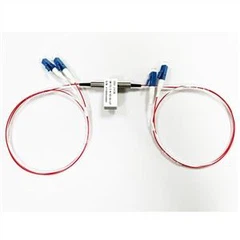


As we all know, optical module is one of the most important active devices in optical transmission equipment. Optical module is a photo electronic module for photoelectric and electro-optical conversion, which plays the role of photoelectric signal conversion. With the rapid development of the network market, the optical module has also been evolving. Now compact optical modules, which are mainly small packages, have been widely popularized and welcomed by the public.
Compact optical module is a hot-plug small package module packaged by SFP. Its main function is to convert the electric signal at the sending end into the optical signal and transmit it out. After receiving the information, the optical signal is restored to the electrical signal at the receiving end. Compact optical module is mainly composed of laser (including transmitter TOSA and receiver ROSA), circuit board IC and external accessories, which are composed of shell, base, PCBA, ring, clasp, unlocking piece and rubber plug.
(1) According to the rate of classification: 155M/622M/1.25 G/2.125 G/4.25G/8 G/10G. 155M and 1.25G are used more in the market.
(2) According to the classification of wavelength: 850nm/1310nm/1550nm/1490nm/1530nm/1610nm. Wavelength of 850nm is multimode; with the transmission distance under 2km. 1310/1550nm wavelength is for single mode, transmission distance above 2km.
(3) According to the distance classification: short distance, medium distance, long distance.
(4) According to the transmission mode: electrical interface, single mode, multimode.
(5)The special type of compact optical module also includes: BIDI-SFP, electrical interface SFP, CWDM SFP, DWDM SFP, SFP+ optical module and so on.
1. Optical emission module TOSA. Optical emission module is the main component of optical emission module, in which the light source laser diode is the core.
2. Receiving component ROSA, the function of the receiving component is to convert the weak optical signal after transmission into electrical signal, and to amplify and reshape the original input electrical signal. The receiving component, ROSA, is composed of a photo detector and a front (Trans resistive) amplifier and other components enclosed in a tight structure. The commonly used ROSA is PIN-TIA and APD-TIA.
3. PCBA board. PCBA is composed of optical emission circuit and receiving circuit.
Can compact optical module be used in SFP+ slot?
Compact optical modules can run in SFP+ slots, but SFP+ optical modules cannot run in compact light slots. SFP+ ports generally do not support speeds below 1G. In other words, we cannot insert 100BASE SFP optical module on SFP+ port. In fact, for this problem, it depends a lot on the switch model.
However, SFP+ optical modules are not automatically compatible to 1G to support SFP optical modules. Unlike copper SFP available in 10/100/1000 automatic compatibility, optical fibers such as SFP and SFP+ do not support automatic compatibility. Although it is possible to use a compact optical module on the SFP+ port in many cases, this does not mean that its insertion into the SFP+ port automatically supports 1G. In a fiber optic link, it may not work if we insert the compact optical module on one SFP+ port (1G) and then on the other SFP+ port (10G).
When use compact optical modules and SFP+ optical modules in a network, make sure that both ends of the fiber link have the same speed. The compact optical module can be used in the SFP+ port, but the compact optical module cannot be connected to the SFP+ optical module.

Compact optical module and SFP+ DAC high-speed cable difference
(1) Compact optical module supports a variety of protocols and applications, such as 100M Ethernet and gigabit Ethernet (GBE), fiber channel (FC), dual channel and bidirectional transmission of synchronous fiber network (SONET). The transmission medium of the compact optical module is single mode fiber (SMF), multi-mode fiber (MMF) and copper cable. Among them, multi-mode fiber can support the 1000base-sx port type in the application of 1GbE.
(2) High-speed SFP+ DAC cable is a passive twin-spindle cable assembly, and directly connected to the SFP+ module. SFP+ direct connection has a fixed length cable, usually 3, 5 or 7 meters in length, using small size cable and small size SFP+ optical module, with the advantages of low power, low cost and low delay. The architecture of the TOR switch has become one of the directions in virtualizing data centers. As the server density of each cabinet increases, the number of interconnections between the server and the access switch increases, the distance is shortened, and the delay is greatly reduced. At this time, the advantage of low cost and power consumption of 10G SFP+ DAC direct connection mode can be best reflected.
The difference between compact optical module and GBIC optical module, SFP+ optical module
(1) Compact optical module is to solve the problem of GBIC optical module volume is too large, its function and GBIC optical module similar, the volume is only half of the latter, more suitable for high-density wiring. In addition, the compact optical module USES LC interface (GBIC optical module USES SC interface), which is to be used together with LC optical fiber jumper. Its transmission rate varies from 100Mbps to 4Gbps, and the transmission distance can reach hundreds of kilometers.
(2) Compact optical module is the same shape of SFP+ optical module, SFP+ optical module is the upgraded version of the compact optical module, and their main difference is the speed.
Note for use of compact optical module and SFP+ DAC high-speed cable

(1) When take the optical module, do not touch the metal connection part of the compact optical module, so as not to damage the optical module.
(2) When insert compact optical module, confirm the compact optical module is attached to the handle of the compact optical module electro-optical port and then insert.
(3) If just out of the compact optical module, do not unplug the light mouth dust plug, directly inserted.
(4) When pull out the compact optical module, first pull out the fiber line, pull the handle to the position of about 90 degrees and slowly pull out, pull out when pulling out cannot be too hard or pull out the handle is not in place, may cause damage to the compact optical module shield.
SFP+ DAC high-speed cable use note
(1) When insert SFP+ DAC high-speed cable, you need to push the SFP+ cable module along the horizontal direction gently into the slot, until close contact with the slot.
(2) When take out the SFP+ DAC high-speed cable, pull the pull ring outward along the horizontal direction to make the cable module unlock, and pull out the cable, at the same time with the hand against the SFP+ module iron shell.
(3) Do not excessive bend, twist the cable in the process of insertion, otherwise it will cause permanent damage.
(4) Do not let the fiber tail is right on your eyes. Do not look into the fiber. Do not see the fiber tail directly or use instruments, laser is not visible, but may cause permanent damage to the human eyes.


